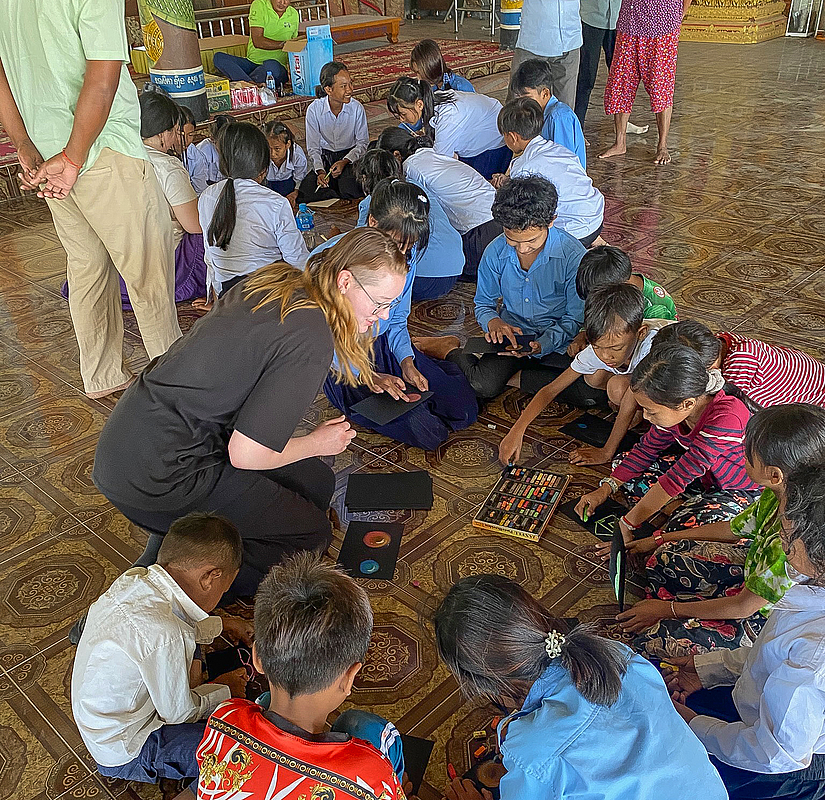
NÜRTINGEN (NGU). Students in the Art Therapy program at Nürtingen-Geislingen University (NGU) carried out the “Color Kaleidoscope” project at a children’s center in Cambodia. The individual paintings and collaborative artworks created during the project will be on display in an exhibition in Nürtingen starting on April 17.
The aim of the project was to create a space where children could playfully explore and creatively express their emotions, experiences, and ideas through artistic and art therapy activities. A particular focus was placed on how cultural influences shape children’s experience and perception of color in Cambodia, and how these influences are reflected in their artwork.
The art therapy project Color Kaleidoscope took place last December and January at the Wat Opot Children’s Community in Cambodia. The project was carried out by art therapy students Noemi Benkeser, Celina El Midani, Diana Demchenko, and Daria Novender under the supervision of Constanze Schulze-Stampa. Funding was provided by the Schmitz Foundations. Founded in 2001 as a hospice for people living with HIV/AIDS, the Wat Opot Children’s Community has since evolved into a daycare and educational center. In the mornings, it operates as a kindergarten for around 30 to 50 children between the ages of two and five, while it offers homework support for school-aged children in the afternoons.
On site, the project team encountered a number of challenges, including constantly changing groups of children, limited English skills, and a performance-based education system. Some educators initially reacted skeptically, asking, “What are you going to teach the little ones?” Despite these doubts, the aspiring art therapists succeeded in creating a safe environment for free creative exploration. Nonverbal communication through facial expressions, gestures, and artistic expression became a universal language that bridged cultural differences and fostered meaningful connections. According to Professor Schulze-Stampa, close relationships with both the children and their caregivers quickly developed; initial hesitation gradually gave way to joy and trust, and the shared creative process became a bridge across linguistic boundaries.
The exhibition presents both individual paintings and collaborative artworks created during the project. According to the organizers, the works stand as vivid testimony to creative potential, the value of intercultural exchange, and the social power of art.
The exhibition opening ceremony will take place on April 17 at 5 p.m. at NGU in Nürtingen, located at Sigmaringer Straße 15/2. The exhibition will remain open to visitors until May 18 during the university’s regular opening hours.